How to Dress Professional for Meetings & Presentations
Skip the intro · jump to the first look ↓
IG: fleurraffan
Okay ladies, we need to sit down and have a real talk about something that literally used to give me stress hives. Getting dressed for big meetings and presentations.
I feel like nobody really teaches us this stuff? You graduate, you get the job, and suddenly you are expected to just magically know how to look like a “professional adult” without looking like you are wearing your mom’s old church clothes. It is such a weird balance to strike. You want to be taken seriously, but you also kinda want to still feel like… well, you.
And honestly, I used to get it so wrong…
Let me tell you about my very first major client presentation a couple years ago. I was 23, fresh in the agency, and I thought “professional” meant “stiff as a board.” So I went to the mall and bought this awful, starchy, light blue button-down shirt. It was literally made of 100% polyester. I paired it with these completely rigid black pencil pants that had zero stretch. Zero. By the time I stood up to present my slides, I was sweating buckets cause the room was hot and the shirt basically acted like a greenhouse. And the worst part? I dropped my clicker, bent down to pick it up, and felt the seam of those rigid pants scream in terror.
Yeah. It was a complete nightmare.
So today I want to share exactly what I do now. The actual, highly wearable, super easy formula for dressing for meetings and presentations. Grab a coffee, let’s get into it.
Rule #1: The “Feel Good, Do Good” Fabric Check
Okay so this is my absolute biggest rule now. If I can’t do a minor lunge or a windmill arm stretch in the outfit, I’m not wearing it to a presentation.
When you are up there talking, your body language is half the presentation. If you feel restricted, you are gonna look closed off and awkward. You need clothes that move with you. Look for blends. A little bit of elastane or spandex in your trousers is literally a lifesaver. You want fabrics that breathe, like cotton, linen blends, or high-quality viscose.
And let’s talk about the sweat factor for a second cause we all get nervous. Do not wear light gray silk if you are a nervous sweater! Just don’t do it to yourself. Stick to darker colors like navy, black, or deep forest green for your top, or wear a structured blazer over a breathable cotton shell so you can keep the blazer on and hide any anxiety sweat. It happens to the best of us, so just plan for it!
Rule #2: Build a Foolproof Base
You know that feeling when you are already running late and you have to put together an outfit from scratch? It is the actual worst. To fix this, I created a “base uniform” for myself.
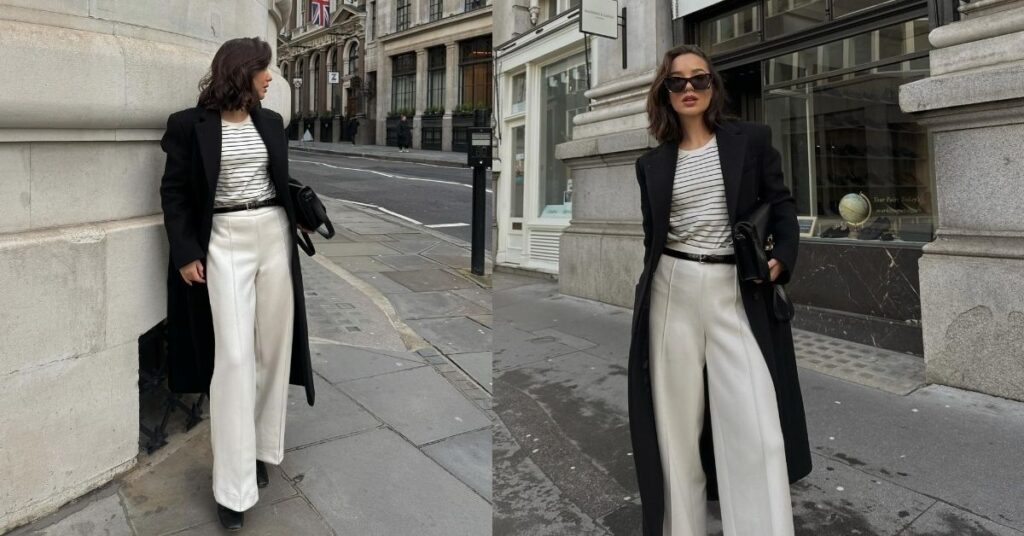
Your base is just your top and your bottoms. Keep it stupidly simple. For me, it is usually a pair of wide-leg, high-waisted black trousers. (Wide-leg pants are amazing cause they look super tailored but feel like pajama pants – total cheat code). And for the top, a high-quality, high-neck fitted t-shirt or a simple ribbed tank top.
That is it. That is the base. You put that on and you already look clean and put together. If you have a solid foundation, you literally cannot mess up the rest.
Rule #3: The Magic of the “Third Piece”
Okay here is where the real magic happens. This is the secret I learned from my old boss who somehow always looked incredibly chic even at 8 AM on a Tuesday.
You have your simple base. Now you add the Third Piece. This is what takes you from “I am just hanging out” to “I am here to crush this meeting.”
The third piece is usually a blazer. But it doesn’t have to be a boring, stuffy one! About a year ago, I was thrifting and I found this slightly oversized, houndstooth men’s blazer. It was like eight dollars. I took it home, gave it a good wash, and threw it over my basic black pants and white tee outfit. You guys. The transformation was crazy.
Suddenly I didn’t look like a scared junior employee anymore. I looked like an art director. I felt so cool. I wore it to a pitch the next week and I swear that blazer gave me a 20% confidence boost. I spoke louder, I made better eye contact.
If blazers aren’t your thing, your third piece could be a really beautiful, thick structured cardigan. Or a cool trench coat if you are out in the field. Or even a statement belt and a chunky necklace.
Rule #4: Let’s Be Real About Shoes
We need to stop pretending that 4-inch heels are required for professionalism. They aren’t. And honestly, nothing ruins your focus faster than throbbing feet.
If you love heels and can run a marathon in them, bless you, go for it. But for the rest of us? Flat shoes are completely fine. The trick is to make sure they are intentionally styled.
A pointed-toe flat, a chunky loafer, or even a super clean, minimal white sneaker can look incredibly professional if the rest of your outfit is sharp. I usually go for my black leather loafers. Like, wipe the scuff marks off. People notice shoes, they really do.
Rule #5: Virtual vs. In-Person (The Zoom Dilemma)
Okay, we have to talk about online meetings. Cause I know we all do the whole “business on top, sweatpants on the bottom” thing. I am totally guilty of it.
But listen to this. Last year I had this huge Zoom presentation with our VP. I wore my favorite nice blouse, did my makeup, looked great from the chest up. But on the bottom? Old fuzzy pajama shorts with cartoon dogs on them.
Right in the middle of presenting, my cat knocked over a full glass of water on my desk. I panicked, jumped up to grab a towel, and backed away from the desk. Yep. The whole executive team got a full view of the cartoon dogs.
So my advice now? Just wear real pants. Even if it is just a nice pair of dark jeans or leggings. Dress the whole body. Not only does it prevent deeply embarrassing accidents, but it also just puts your brain in work mode. When you wear pajamas, your brain still kinda thinks you are relaxing.
Rule #6: Grooming is Half the Battle
This is something people skip over a lot when talking about dressing professional. But the clothes are only part of it.
You can wear a $500 blazer, but if your hair is a greasy mess and you look like you just rolled out of bed, it kinda defeats the purpose, you know? You don’t need a full face of glam makeup at all. Sometimes I literally just wear mascara and lip balm.
It is all about looking intentional.
Rule #7: Do a Dress Rehearsal
If you have a really, really important presentation coming up, do not wear a brand new outfit that you haven’t tested out yet. Just don’t. Learn from my polyester nightmare.
Put the whole outfit on the night before. All of it. The shoes, the underwear, the jewelry. Walk around your apartment. Sit down in a chair. Does the shirt gape open when you sit? Do the pants ride up weirdly? Does the necklace clank against your mic if you are presenting? Figure all of that out the night before so you aren’t stressing about it on the big day.
I always lay my clothes out the night before, right down to the socks. It takes away so much decision fatigue in the morning.